How To Choose Kitchen Countertops That Fit Your Life In Pittsburgh, Pennsylvania
Explore quality granite Pittsburgh options from Top It Off, Inc., with granite, quartz, soapstone, sinks, and remnant countertops for local kitchens.
Key Takeaways
- The best countertop is the one that fits how your household actually uses the kitchen.
- Quartz, granite, quartzite, marble, soapstone, and solid-surface products each have different strengths.
- Heat, stains, scratches, moisture, maintenance, and fabrication details all matter.
- Viewing a full slab can reveal movement and color variation that a small sample cannot show.
- Installation quality is as important as the countertop material itself.
- Remnants can be practical for vanities, bars, laundry rooms, and other smaller surfaces.
Choosing a countertop for a Pittsburgh-area kitchen starts with more than picking a color. The right surface needs to suit your cooking habits, your cleaning routine, the amount of natural light in the room, and the character of your home, whether it is a city rowhouse, a North Hills family kitchen, or a Butler County renovation.
For homeowners comparing quality granite Pittsburgh options, Top It Off, Inc. is a countertop company based in Evans City, Pennsylvania, serving the greater Pittsburgh region with granite, quartz, soapstone, sinks, and remnant options. A local stone specialist can help homeowners view material choices at full-slab scale and plan details such as seams, edges, and cutouts before installation begins.
Start with the Daily Kitchen Use
Before falling in love with veining or a polished finish, consider what happens on the counter every day. A household that cooks large dinners, bakes often, packs lunches, and hosts game-day gatherings may need a different surface than a kitchen used mainly for coffee and quick meals.
Ask practical questions. Do hot pans regularly land near the cooktop? Will children use the island for homework and snacks? Are spills wiped quickly? Does sunlight pour through large windows? A serious baker may appreciate a cool natural-stone work surface, while a busy family may prioritize straightforward cleanup and a consistent appearance.
Compare Countertop Materials
Quartz
Quartz countertops are engineered surfaces made from quartz minerals and binding materials. They are often selected for their uniform appearance, broad color selection, and uncomplicated daily cleaning. Use trivets for hot cookware, since heat can damage the resin components in engineered surfaces.
Granite And Quartzite
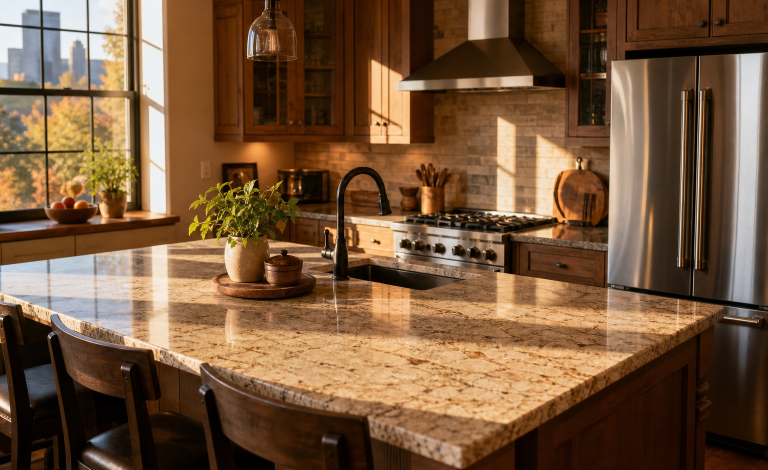
Granite is a natural stone, so each slab can have its own mineral patterns, color shifts, and movement. Quartzite is also a natural stone, not the same product as engineered quartz. It can offer dramatic veining and a stone-forward look, but individual slabs vary, making in-person selection especially valuable. The geological distinction behind quartzite as a metamorphic rock also helps explain why it should not be treated as another name for quartz.
Marble, Soapstone, And Other Options
Marble brings classic veining and can develop etching from acidic foods. Soapstone has a softer, matte appearance and develops a patina over time. Solid surface, porcelain, laminate, butcher block, and stainless steel can also work well when their seam visibility, heat tolerance, moisture exposure, repairability, and maintenance needs fit the project.


Consider Everyday Performance
Appearance matters, but performance is what homeowners live with. Compare materials using these questions:
- Heat: Will you need a trivet every time hot cookware leaves the stove?
- Stains: How quickly should coffee, oil, wine, and tomato sauce be cleaned?
- Scratches: Will knives, cookware, or everyday objects leave visible marks?
- Moisture: How will the surface perform around a sink, dishwasher, and wet dishes?
- Maintenance: Does the material need periodic sealing or manufacturer-approved products?
Match The Surface To The Room
Pittsburgh homes often mix old and new elements, such as original woodwork with modern cabinets or an updated kitchen within a traditional floor plan. Bring cabinet doors, flooring pieces, backsplash samples, and hardware to the slab selection process. Check them in daylight and under the kitchen’s planned lighting.
Bold veining can become a focal point in a simple room. In a kitchen with patterned tile, detailed cabinetry, or busy flooring, a quieter surface may create better balance. Also, compare polished, honed, and textured finishes, then choose an edge profile that supports the design. A simple eased edge works in many settings, while more detailed edges can complement traditional cabinetry.
Build A Complete Budget
The slab price is only one part of a countertop project. Request an itemized estimate that identifies material selection, measurements, fabrication, edge work, sink and cooktop cutouts, delivery, installation, removal of existing tops, and any plumbing coordination. This makes it easier to compare proposals accurately.
For a bathroom vanity, small island, bar, or laundry counter, ask whether a remnant fits the dimensions. A remnant can make efficient use of a smaller stone piece when a full slab is unnecessary.
Choose The Right Fabricator
Careful fabrication and installation protect the investment. Ask who will template the kitchen, whether you can inspect the slab, where seams are likely to fall, how the cabinets will be checked for support, and who coordinates sink and cooktop cutouts. Discuss seam placement before installation day, particularly with strongly veined natural stone.
Fabrication should also be handled with appropriate safety controls. Cutting and grinding stone can create respirable crystalline silica, which is why OSHA’s guidance on crystalline silica emphasizes controls for work that generates silica dust.
Plan For Long-Term Care
Follow the care guidance for your specific material and finish. In general, wipe surfaces with a soft cloth and an appropriate cleaner, clean spills promptly, use cutting boards, and avoid harsh products unless the manufacturer or fabricator approves them. Natural stone may need sealing, but the correct schedule depends on the stone, finish, sealer, and level of use.
Avoid Common Countertop Mistakes
- Choosing from a small sample without viewing the full slab.
- Ignoring natural and artificial lighting.
- Comparing only the price per square foot.
- Forgetting cutouts, edge details, and plumbing coordination.
- Assuming quartz and quartzite are the same material.
- Leaving seams and cabinet-support questions until the last minute.
- Using cleaners that are not suitable for the selected surface.
Frequently Asked Questions
What Is The Best Countertop Material For A Busy Kitchen?
There is no single answer. Quartz can suit homeowners seeking low routine maintenance, while granite and quartzite can appeal to people who value natural variation and stone character.
Is Granite Still A Good Choice In 2026?
Yes. Granite remains a practical option for homeowners who enjoy natural variation and are prepared to follow the recommended care plan for their specific slab and finish.
Are Remnants Good For Small Projects?
Yes. Remnants can be a strong fit for vanities, shelves, compact islands, wet bars, and laundry-room counters.
Should Countertops Be Chosen Before Cabinets?
Either order can work, but cabinet color, countertop material, backsplash, flooring, and hardware should be reviewed together before final selections are made.
Conclusion
The right countertop should support the way your Pittsburgh kitchen works, not simply look good in a showroom. By weighing daily use, performance, style, total cost, installation planning, and long-term care, homeowners can choose a surface that feels right from the first meal through years of everyday use.